Louisville
Louisville, Kentucky, serves as the lost origin of Jay Gatsby's dream and the geographical anchor of his romantic obsession. It is the city where Daisy Fay, before she became Daisy Buchanan, lived as a beautiful and sought-after young heiress, and where she first met Gatsby, a young army officer, in 1917. The city represents a past so perfect in Gatsby's imagination that he believes it can be physically re-entered and re-lived, a conviction that drives the novel's central conflict and ultimately leads to his destruction.
Daisy's Louisville: The World of the Golden Girl
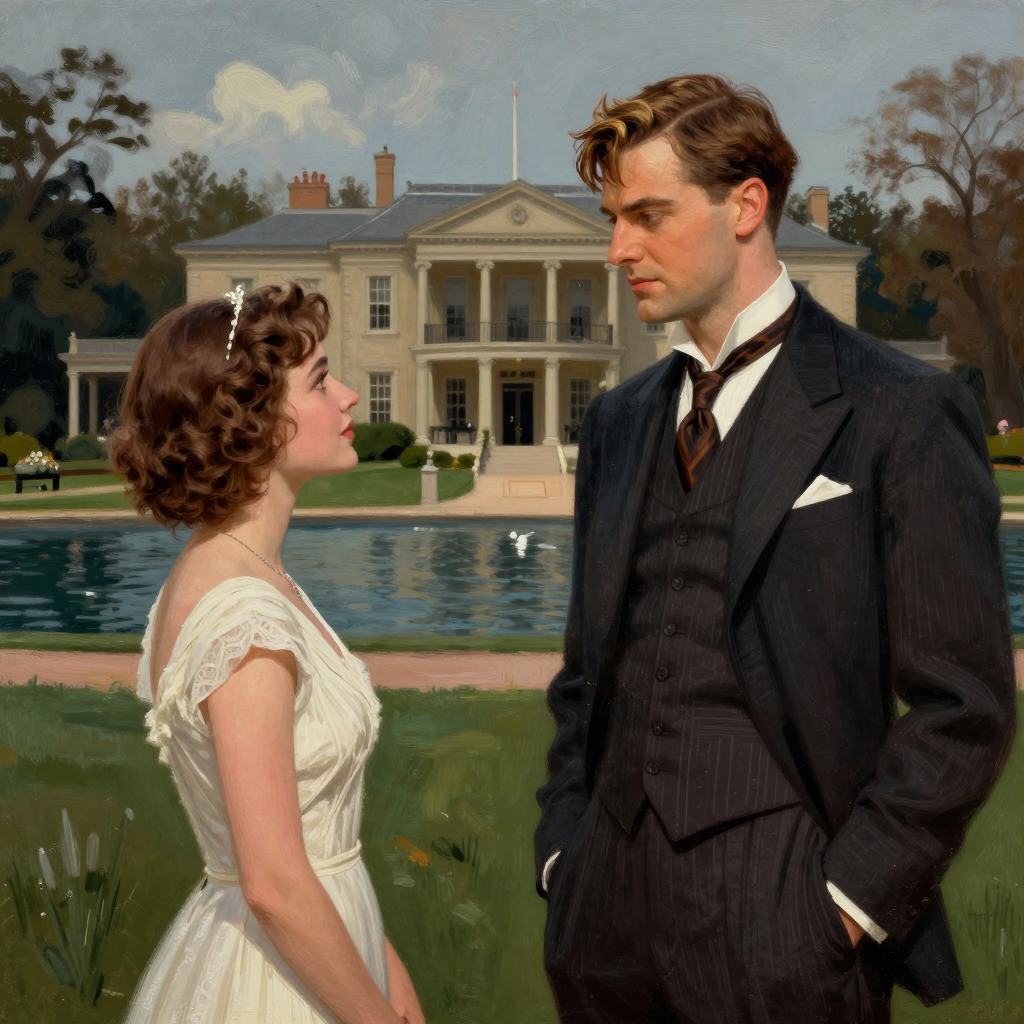
Louisville was the setting of Daisy Fay's privileged girlhood. She was the most popular young woman in the city, dressed in white and driving a little white roadster, with the telephone ringing all day as officers from Camp Taylor competed for her attention. Her house, with the largest lawn and the largest banners, was a place of breathless intensity for Gatsby, who had never been in such a beautiful house before. It was in this house that Daisy, at eighteen, sat in her white car with a lieutenant Gatsby, so engrossed in each other that she did not notice Jordan Baker approaching. The city itself, for Gatsby, became pervaded with a melancholy beauty, its streets holding the memory of their footsteps clicking together through November nights. Daisy's Louisville was a world of orchids, cheerful snobbery, and orchestras that set the rhythm of the year, a world of golden and silver slippers shuffling the shining dust, a universe that Gatsby could only enter by a colossal accident.
The Failed Escape and the Marriage to Tom
Louisville was also the scene of Daisy's failed attempt to escape her fate and her subsequent surrender to it. Wild rumors circulated that her mother had found her packing a bag one winter night to go to New York to say goodbye to a soldier going overseas. She was prevented, but was not on speaking terms with her family for weeks. The following June, she married Tom Buchanan of Chicago in Louisville with more pomp and circumstance than the city had ever known. Tom arrived with a hundred people in four private cars, hired a whole floor of the Seelbach Hotel, and gave her a string of pearls valued at three hundred and fifty thousand dollars. Yet, half an hour before the bridal dinner, Daisy was found drunk on her bed, clutching a letter—presumably from Gatsby—and demanding to return the pearls, saying she had changed her mind. She was forced into a cold bath, the letter dissolved in the water like snow, and the next day she married Tom without a shiver. Louisville thus witnessed both the height of her romantic passion and the moment of its violent suppression.
Gatsby's Return and the Unrepeatable Past
After the war, Gatsby made a miserable but irresistible journey to Louisville on the last of his army pay, even though Tom and Daisy were still on their wedding trip. He stayed for a week, walking the streets where they had walked together, revisiting the out-of-the-way places they had driven to in her white car. He left feeling that if he had searched harder, he might have found her. This conviction that the past can be physically reclaimed is the core of Gatsby's dream. He later tells Nick Carraway that after Daisy is free, they are to go back to Louisville and be married from her house, just as if it were five years ago. When Nick protests that one cannot repeat the past, Gatsby cries out incredulously, "Can't repeat the past? Why of course you can!" Louisville is the tangible location of this impossible ambition, the place where he believes he can fix everything just the way it was before.
The City's Final Significance: A Lost World
Louisville ultimately represents the irrecoverable world of Gatsby's youth and the unattainable object of his desire. It is the city where Daisy drew her breath, and when Gatsby left it for the last time, he stretched out his hand desperately as if to snatch only a wisp of air, to save a fragment of the spot that she had made lovely for him. The city, even though she was gone from it, was pervaded with a melancholy beauty. In the novel's final reckoning, Louisville is the geographical embodiment of the past that cannot be recaptured, the green light that recedes before Gatsby as he beats on, boats against the current, borne back ceaselessly into the past. It is the place where his dream was born and the place where it was forever lost.